Torvenixarex
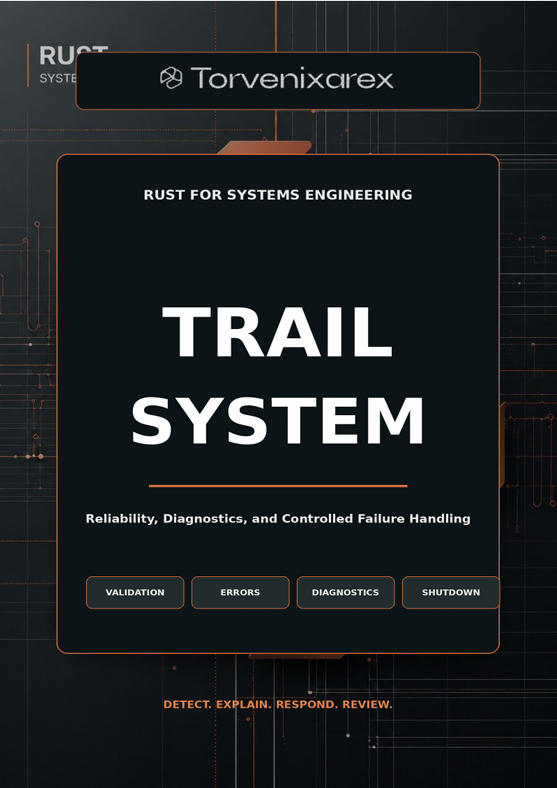
Trail System
Trail System
Couldn't load pickup availability
- ⬇️ Digital file available after purchase
- ♾️ Long-term availability
- 🔒 Secure checkout
- 🗓️ Content updated in 2026
Self-paced learning overview
Problem Statement
As Rust systems become larger and more connected, learners need to consider how programs behave when inputs are incomplete, resources become unavailable, operations fail, or unexpected states appear. A program may work during ordinary testing yet become difficult to diagnose when several components interact under unusual conditions.
The Trail System addresses this stage by focusing on reliability, observability, failure handling, and structured operational behavior.
Solution
The Trail System teaches learners how to design Rust components that respond to faults in a clear and organized way. The course explores how errors travel through a system, how useful context can be attached to them, and how components can report their state without exposing unnecessary implementation details.
Each module combines technical explanations with system diagrams, code review tasks, fault scenarios, and guided exercises. The focus remains on thoughtful engineering choices rather than claiming that every failure can be prevented.
What’s Inside
The guided project asks learners to extend a multi-component systems utility with validation, diagnostic reporting, recovery boundaries, health information, and orderly shutdown behavior.
Who Is This For?
This tier is intended for:
- Learners who completed the Vertex Guide
- Programmers building connected Rust components
- Students studying reliability and fault handling
- Developers improving diagnostic clarity
- Learners working with long-running processes
- Programmers preparing for deeper performance and systems analysis
Familiarity with Rust architecture, modules, traits, asynchronous tasks, concurrency, testing, and structured error handling is recommended.
What You’ll Learn
- Design clear error types for system components
- Add useful context without hiding the original failure
- Separate validation from processing logic
- Distinguish temporary conditions from permanent faults
- Apply controlled retry rules
- Create fallback paths for selected situations
- Plan orderly shutdown sequences
- Release resources during interrupted operations
- Record diagnostic events in a structured format
- Trace work across connected components
- Report component health clearly
- Test failure paths deliberately
- Introduce faults during controlled exercises
- Define boundaries that contain failures
- Review incidents and identify design improvements
- Prepare for deeper systems analysis in the Anchor System
Guarantee
- 30-day money back
- Risk-free
Certification
The course include a certificate of completion, giving learners a clear way to confirm their progress and showcase their achievement.
Share
How are the Torvenixarex course tiers organized?
How are the Torvenixarex course tiers organized?
The course tiers follow an ascending learning structure. Earlier tiers introduce foundational concepts and study habits, while later tiers explore broader systems engineering topics, larger code structures, and more detailed technical reasoning.
Do I need previous systems programming experience?
Do I need previous systems programming experience?
Not for the introductory tiers. The learning path begins with foundational explanations and gradually introduces more detailed material. Each tier states the recommended background so learners can choose a suitable starting point.
What format do the courses use?
What format do the courses use?
Each tier contains structured modules, written explanations, code examples, guided exercises, review prompts, and practical activities. The exact depth and range of materials increase as the tiers progress.