Torvenixarex
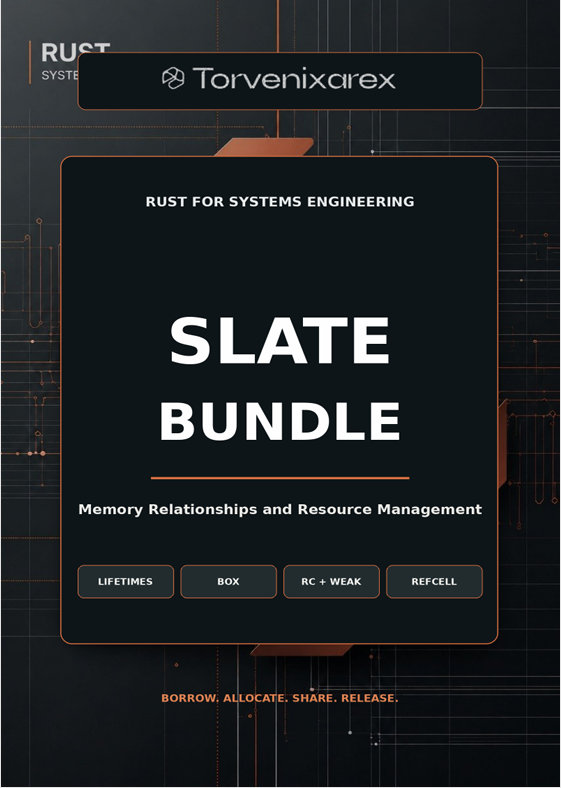
Slate Bundle
Slate Bundle
Couldn't load pickup availability
- ⬇️ Digital file available after purchase
- ♾️ Long-term availability
- 🔒 Secure checkout
- 🗓️ Content updated in 2026
Self-paced learning overview
Problem Statement
As Rust programs become larger, learners need to think more carefully about how data is stored, borrowed, shared, and released. Basic ownership rules provide a strong foundation, but more involved systems programs may require longer-lived references, heap-allocated values, shared ownership, interior mutability, and structured cleanup.
The Slate Bundle addresses this stage by presenting resource management as a connected set of design decisions rather than a collection of isolated language features.
Solution
The Slate Bundle provides a detailed introduction to lifetimes, heap allocation, smart pointers, shared data, interior mutability, and automatic resource cleanup.
Guided examples show how values move between stack and heap storage, how shared ownership can be represented, and how cleanup behavior can be attached to a type. Practice activities encourage learners to inspect memory relationships, identify unsuitable designs, and revise code with clearer resource boundaries.
What’s Inside
The materials contain annotated code samples, ownership diagrams, comparison tables, compiler-feedback exercises, refactoring tasks, and a guided resource-management project.
The project asks learners to design a small component that stores linked data, shares selected values, manages changing internal state, and releases resources through clearly defined behavior.
Who Is This For?
This tier is intended for:
- Learners who completed the Cryst Set
- Programmers comfortable with structures, enumerations, and traits
- Students studying memory and resource relationships
- Developers preparing for larger systems components
- Learners who want to understand smart pointer choices
- Programmers interested in structured cleanup behavior
A working understanding of ownership, borrowing, methods, traits, generic types, pattern matching, and error handling is recommended.
What You’ll Learn
- Distinguish stack storage from heap storage
- Explain how reference lifetimes relate to stored values
- Add lifetime annotations when relationships need clarification
- Use references safely within structures
- Store values through heap allocation
- Compare single ownership with shared ownership
- Use reference counting for shared data
- Apply weak references to reduce ownership-cycle problems
- Explain interior mutability
- Work with runtime borrowing checks
- Define cleanup behavior for custom types
- Wrap resources in types with clear ownership rules
- Read compiler messages related to lifetimes
- Identify unsuitable pointer choices
- Refactor code with clearer resource boundaries
Guarantee
- 30-day money back
- Risk-free
Certification
The course include a certificate of completion, giving learners a clear way to confirm their progress and showcase their achievement.
Share
How are the Torvenixarex course tiers organized?
How are the Torvenixarex course tiers organized?
The course tiers follow an ascending learning structure. Earlier tiers introduce foundational concepts and study habits, while later tiers explore broader systems engineering topics, larger code structures, and more detailed technical reasoning.
Do I need previous systems programming experience?
Do I need previous systems programming experience?
Not for the introductory tiers. The learning path begins with foundational explanations and gradually introduces more detailed material. Each tier states the recommended background so learners can choose a suitable starting point.
What format do the courses use?
What format do the courses use?
Each tier contains structured modules, written explanations, code examples, guided exercises, review prompts, and practical activities. The exact depth and range of materials increase as the tiers progress.