Torvenixarex
Halo Space
Halo Space
Couldn't load pickup availability
- ⬇️ Digital file available after purchase
- ♾️ Long-term availability
- 🔒 Secure checkout
- 🗓️ Content updated in 2026
Self-paced learning overview
Problem Statement
After working with concurrent tasks, message passing, shared state, and synchronization, learners often encounter programs that spend significant time waiting for external input, scheduled work, or resource availability. Traditional task coordination can become inefficient when each operation occupies a worker while waiting.
The Halo Space addresses these challenges by explaining asynchronous Rust through practical systems engineering situations and carefully organized examples.
Solution
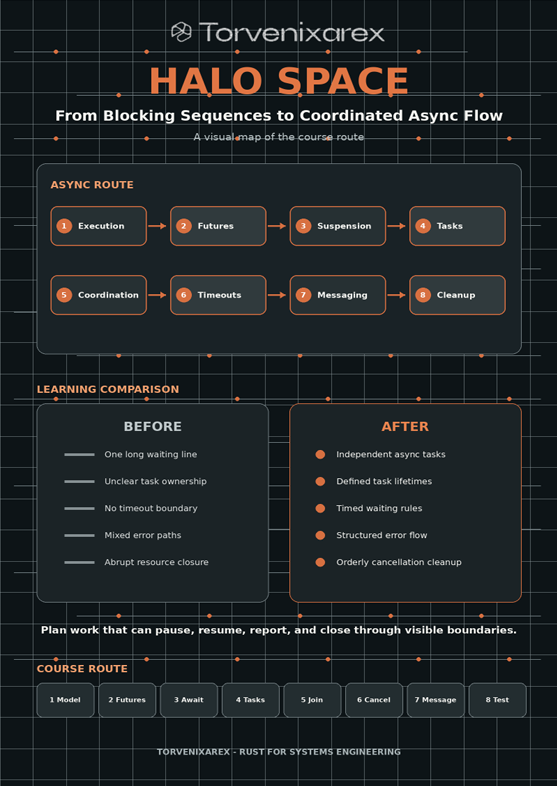
The Halo Space introduces asynchronous design as a method for coordinating work that may pause and resume. Learners examine how asynchronous functions produce future values, how tasks progress, and how waiting operations can be arranged without blocking other work.
Each module includes diagrams, annotated examples, guided exercises, and review tasks. The materials help learners reason about execution order, resource ownership, and error boundaries in programs with several active operations.
What’s Inside
The materials contain execution diagrams, flow-tracing activities, compiler-feedback exercises, debugging scenarios, code-restructuring tasks, and a guided event-processing project.
The project asks learners to build a small coordinator that receives events, processes several operations, manages time limits, reports errors, and closes active resources in a clear sequence.
Who Is This For?
This tier is intended for:
- Learners who completed the Flow Asset
- Programmers familiar with task coordination and message passing
- Students exploring non-blocking program structures
- Developers working with waiting operations and event-driven components
- Learners preparing for broader systems architecture
- Programmers interested in asynchronous resource management
A working understanding of ownership, borrowing, closures, error handling, shared state, communication channels, and concurrent task concepts is recommended.
What You’ll Learn
- Explain how asynchronous tasks pause and resume
- Describe the role of futures
- Write and call asynchronous functions
- Identify suspension points in program flow
- Coordinate several asynchronous operations
- Compare sequential and concurrent execution
- Add time limits to waiting operations
- Handle task cancellation thoughtfully
- Pass messages between asynchronous components
- Manage shared state without obscuring ownership
- Propagate errors across task boundaries
- Clean up resources after interruption
- Recognize lifetime concerns around suspended work
- Trace task execution through complex flows
- Test asynchronous behavior
- Organize asynchronous code into clear modules
Guarantee
- 30-day money back
- Risk-free
Certification
The course include a certificate of completion, giving learners a clear way to confirm their progress and showcase their achievement.
Share
How are the Torvenixarex course tiers organized?
How are the Torvenixarex course tiers organized?
The course tiers follow an ascending learning structure. Earlier tiers introduce foundational concepts and study habits, while later tiers explore broader systems engineering topics, larger code structures, and more detailed technical reasoning.
Do I need previous systems programming experience?
Do I need previous systems programming experience?
Not for the introductory tiers. The learning path begins with foundational explanations and gradually introduces more detailed material. Each tier states the recommended background so learners can choose a suitable starting point.
What format do the courses use?
What format do the courses use?
Each tier contains structured modules, written explanations, code examples, guided exercises, review prompts, and practical activities. The exact depth and range of materials increase as the tiers progress.