Torvenixarex
Flow Asset
Flow Asset
Couldn't load pickup availability
- ⬇️ Digital file available after purchase
- ♾️ Long-term availability
- 🔒 Secure checkout
- 🗓️ Content updated in 2026
Self-paced learning overview
Problem Statement
After developing a clearer understanding of ownership, lifetimes, smart pointers, and resource management, learners often reach a point where they need to coordinate several tasks within the same Rust program. This introduces new questions about shared state, message passing, task scheduling, synchronization, and safe communication between concurrent operations.
Rust provides strict rules that help identify many unsafe data-sharing patterns during compilation. However, learners still need to understand how to choose an appropriate coordination method, organize shared resources, and keep concurrent code readable.
Solution
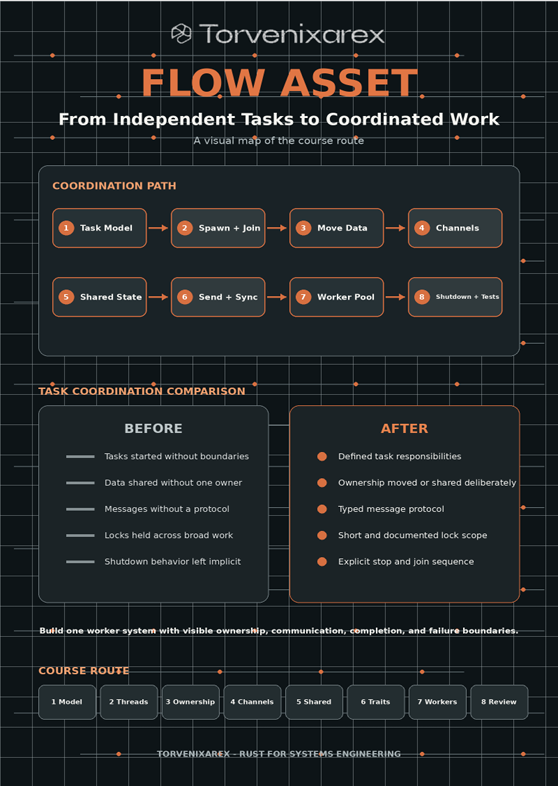
The Flow Asset introduces concurrency as a set of clear engineering decisions. Learners study how independent tasks are created, how messages move between them, and how shared data can be protected through synchronization tools.
Each module combines conceptual explanations with annotated code, diagrams, debugging activities, and guided implementation tasks. Learners gradually move from small task examples to a coordinated systems component with several interacting parts.
What’s Inside
The materials include execution-flow diagrams, synchronization comparisons, compiler-feedback exercises, code-review prompts, and a guided worker-system project.
The project asks learners to build a small task coordinator that receives work items, distributes them across workers, collects results, records shared state, and closes resources in an orderly way.
Who Is This For?
This tier is intended for:
- Learners who completed the Slate Bundle
- Programmers familiar with ownership and smart pointers
- Students exploring concurrent systems design
- Developers working with shared resources
- Learners interested in message-based coordination
- Programmers preparing for asynchronous engineering topics
Familiarity with structures, traits, closures, error handling, heap allocation, shared ownership, and interior mutability is recommended.
What You’ll Learn
- Create and coordinate concurrent tasks
- Move owned data into task closures
- Send values through communication channels
- Receive and process messages safely
- Work with multiple message producers
- Protect shared state with synchronization tools
- Combine reference counting with shared mutation
- Interpret thread-safety requirements
- Recognize common locking concerns
- Reduce unnecessary shared state
- Organize worker-based processing
- Handle task errors without obscuring program flow
- Close communication resources correctly
- Write tests for concurrent components
Guarantee
- 30-day money back
- Risk-free
Certification
The course include a certificate of completion, giving learners a clear way to confirm their progress and showcase their achievement.
Share
How are the Torvenixarex course tiers organized?
How are the Torvenixarex course tiers organized?
The course tiers follow an ascending learning structure. Earlier tiers introduce foundational concepts and study habits, while later tiers explore broader systems engineering topics, larger code structures, and more detailed technical reasoning.
Do I need previous systems programming experience?
Do I need previous systems programming experience?
Not for the introductory tiers. The learning path begins with foundational explanations and gradually introduces more detailed material. Each tier states the recommended background so learners can choose a suitable starting point.
What format do the courses use?
What format do the courses use?
Each tier contains structured modules, written explanations, code examples, guided exercises, review prompts, and practical activities. The exact depth and range of materials increase as the tiers progress.