Torvenixarex
Anchor System
Anchor System
Couldn't load pickup availability
- ⬇️ Digital file available after purchase
- ♾️ Long-term availability
- 🔒 Secure checkout
- 🗓️ Content updated in 2026
Self-paced learning overview
Problem Statement
After learners begin designing for reliability, fault handling, observability, and controlled recovery, the next challenge is understanding how a system behaves under demanding workloads. A program may be logically correct yet still use more memory, processing time, or system resources than expected.
Learners may attempt to improve speed too early or change code without collecting useful measurements. This can create additional complexity while offering little practical benefit. The Anchor System addresses this stage by teaching a careful, measurement-guided approach to performance analysis and resource efficiency.
Solution
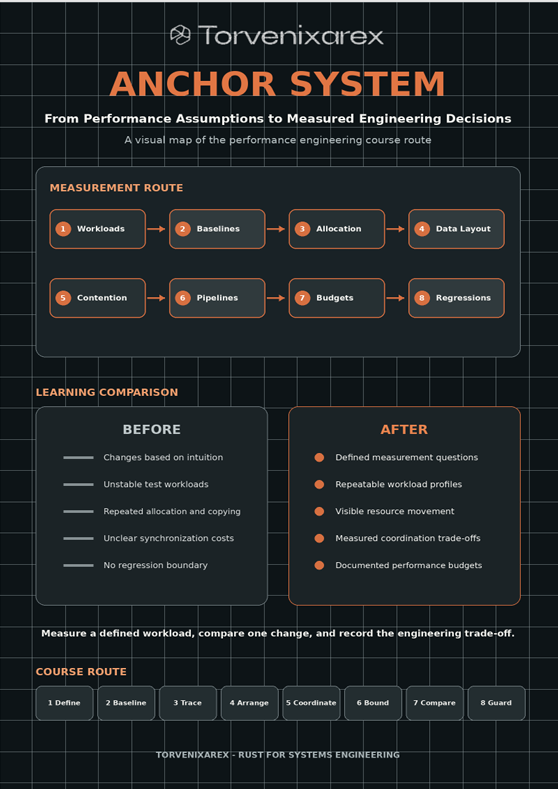
The Anchor System introduces performance engineering as a structured process of observation, measurement, comparison, and revision.
Learners examine how program structure affects memory usage, allocation patterns, data movement, task coordination, and processing cost. The course explains how to identify areas worth investigating, create meaningful benchmarks, and compare alternative implementations.
Each module combines conceptual explanations with code analysis, measurement exercises, design comparisons, and guided optimization tasks.
What’s Inside
The Anchor System includes modules covering:
The materials include annotated examples, resource-flow diagrams, benchmark exercises, code comparison tasks, review questions, and a guided performance-analysis project.
The project asks learners to examine a systems component, identify measurable resource concerns, compare several implementation choices, and document the reasoning behind each revision.
Who Is This For?
This tier is intended for:
- Learners who completed the Trail System
- Programmers examining Rust system performance
- Students studying memory and processing efficiency
- Developers working with concurrent workloads
- Learners improving resource-aware program design
- Programmers preparing for broader system integration
Familiarity with ownership, borrowing, collections, traits, concurrency, asynchronous workflows, architecture, testing, and reliability concepts is recommended.
What You’ll Learn
- Create focused performance measurements
- Distinguish useful measurements from misleading results
- Identify repeated allocation and copying
- Reduce unnecessary data movement
- Compare data structures for different workloads
- Use iterators for structured data processing
- Examine data layout and memory locality
- Evaluate synchronization costs
- Recognize contention between tasks
- Apply buffering and batching where appropriate
- Design clearer processing pipelines
- Introduce resource limits and backpressure
- Compare alternative implementations
- Test for performance regressions
- Interpret measurement data carefully
Guarantee
- 30-day money back
- Risk-free
Certification
The course include a certificate of completion, giving learners a clear way to confirm their progress and showcase their achievement.
Share
How are the Torvenixarex course tiers organized?
How are the Torvenixarex course tiers organized?
The course tiers follow an ascending learning structure. Earlier tiers introduce foundational concepts and study habits, while later tiers explore broader systems engineering topics, larger code structures, and more detailed technical reasoning.
Do I need previous systems programming experience?
Do I need previous systems programming experience?
Not for the introductory tiers. The learning path begins with foundational explanations and gradually introduces more detailed material. Each tier states the recommended background so learners can choose a suitable starting point.
What format do the courses use?
What format do the courses use?
Each tier contains structured modules, written explanations, code examples, guided exercises, review prompts, and practical activities. The exact depth and range of materials increase as the tiers progress.